The BestJudo Blog

Rambling Thoughts on Judo - from an old-timer Judoka.

March 20th, 2007

Yes! I have an Excuse…

You haven’t been seeing very many posts recently - but yes, I do have an excuse.  I’m working on a new Judo website that when finished - will probably take the place of ‘BestJudo’.

Unfortunately, it will be at least another month or two before it’s ready to show the world - but when it’s ready - those who visit Best Judo will get the news before anyone else does.

Sorry to be so ’secretive’ - but in my experience, websites fail most often when they have little to no content prior to being released to the world … people come with high expectations, find little or no content, and write the website off.

So please remain patent… the new site is coming soon!

February 17th, 2007

Kenka Yotsu in Uchikomi - Don’t Forget it!

Those who’ve ever paid attention while I’m teaching a class know the emphasis I keep placing on being able to attack to the left side.  It’s a skill that is desperately needed the higher you go in competition.

Interestingly, George Weers did a study (http://www.judoinfo.com/weers2.htm) on grips - and mentions that while examining over 500 top level matches, the grip stances were split virtually 50/50.  Now, any knowledgeable person would never assert that lefties comprise 50% of the population - so perhaps my students might figure out that what I’m saying about learning to handle throws to the left side … just might be based on more than the wild rantings of a Judo old-timer…

This interesting stat that George Weers developed means that a very large percentage of matches fought at the higher levels of Judo are going to be Kenka Yotsu - or opposite grips.  (you take a right-handed grip, and your opponent takes a left handed grip)

Now, if you aren’t regularly practicing Kenka Yotsu in your uchikomi or randori - you’re going to be badly flustered the first time you encounter someone in shiai that doesn’t take the standard right hand grip.  I often attribute what success I’ve had in competition to the fact that I learned early on that few Judoka could handle left-handers… so I switched to being a ‘lefty’, despite being a complete right hander in everything else.

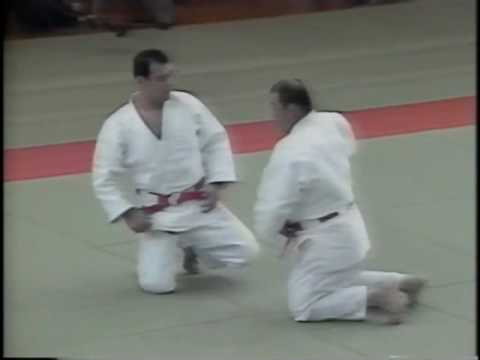
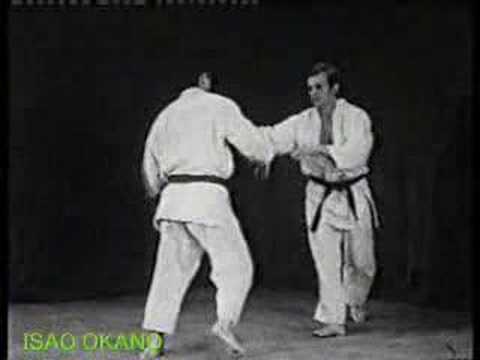
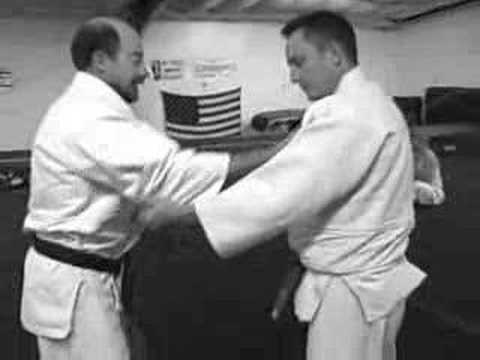
Kenka YotsuThe problem that is bound to come up is that in Kenka Yotsu, both you and your opponent have your ‘Power Hand’ on the same side.  In a right handed grip, your power hand is your right forearm - which will be, in many throws; placed squarely on uke’s chest.  But if your opponent also has his power arm on the same side - one person is going to ‘take the inside’.  Viewing the photo here, you’ll see that the Judoka on the right has the inside, and therefore could begin a throw.  The Judoka on the left would be unable to exert maximum force until -he- takes the inside on his lapel grip.

Taking the inside - this is critical, if you have the inside grip, your opponent cannot place his forearm on your chest, and has, as a result, a tremendously lesser ability to exert force on you.  The problem is the construction of the arm… if you exert force with your hand only - your elbow makes your arm act as a spring… you can’t put maximum force along your arm (unless you lock the elbow!) because your arm will flex at the elbow.  This is why in many throws, it’s critical to ’set the power arm’ by slamming your forearm against uke’s chest… there’s no ’spring action’ of the elbow to worry about.

So how do you ‘take the inside’ if both of you are in Kenka Yotsu?  One of you will already be on the inside - you should make every attempt to make sure that you are that person.  Or be capable of ‘taking the inside’ at a moments notice.

There are two basic ways to do it - you can drop your grip and circle your hand up under uke’s arm to retake the lapel grip … putting you on the inside.  Not recommended!  If someone drops a grip, I have no particular desire to make it easy for my opponent to regain it - also, if I have a two handed grip, and my opponent only has his locking arm grip - that’s the perfect opportunity for me to throw him.

The second, and to my way of thinking, best way to take the inside is more easily executed than described in words… looking at the photo above, imagine that you’re the Judoka on the left… you push with your left hand until both you and your uke are ’straight-armed’ from each other.  At that time, your power arm will be above and just slightly to the outside of uke’s power arm.  Simply twist your arm slightly, bringing your elbow to the inside… then drop your elbow - pushing uke to the outside.

Also, don’t fail to appreciate how your body movement can help you take the inside.  This is something that you need to spend some uchikomi time with… I recommend that you switch throws with your uke during uchikomi… first you ‘take the inside’ and execute your throwing attack… then your partner must now take the inside and execute his throwing attack… and so forth.

Combine this with a few attacks that you can execute from the left grip rather than the right - and you’ll have a surprise up your sleeve for the next shiai… good luck!

(Photo scanned from Neil Adam’s excellent ’Masterclass’ book on Grips)

January 8th, 2007

Uchikomi & Newaza - the Forgotten Combination.

Most Judoka practice at least some Uchikomi during standup practice at every practice, but how many Judoka realize that Uchikomi is just as valuable on the mat?

When drilling a new pin variation, turnover, or guard entry - you should be doing it multiple times… and do it as AnnMarie De Mars - former World Champion, recommends: try to speed it up each time.  Make your goal to be as fast as you can with the given technique.

I have a favorite technique to attack a turtle with, it’s really a trap move - but I’ve drilled it so many times that when someone gives me the opening, it’s a foregone conclusion that they’ve lost to the armbar that results.  I’ve picked up a few Ippons during my long-past days of competition with this move - and it’s only because I’ve drilled, drilled, and drilled some more that it’s been so effective for me.  (No-one at the Encino Judo club would be puzzled by this comment - they know exactly what technique I’m referring to… I’ve done it a few times… :) )

So keep this in mind for your next practice session - when you go to the ground, practice uchikomi there as well as in your throwing practice.

December 5th, 2006

Brown Belts - the Sergeants of Judo…

Having spent about a decade in the Marine Corps, I’m well aware that the Marine Corps runs on the talent and ability of Sergeants.  The Officers may garner all the publicity, make the decisions, and give the ultimate orders - but it’s the lowly Sergeants that carry the day.

The same thing can be seen in the average dojo.  The Black belts can be compared to Marine Corps Officers - they give the ‘orders’, they provide the training schedule … but it’s the brown belts who really help the class.

Who else can lead the beginning exercises when my knee is feeling the weather?

Who else can serve as uke for a particularly hard throw?

Who else can serve as the eyes of the Sensei … helping with minor corrections for poor technique?

What brings these thoughts to mind is a class coming up later this week, where I’ll be taking over a Judo class (next town over….) for another instructor.  And the one brown belt who normally attends that particular class is going to be at another Judo club for the first hour or so…

So naturally, I’m pulling what remains of my hair out… I’m going to face the class COMPLETELY ALONE, without any brown belts to help me out!  (Do I hear the faint sound of a small violin playing?  Perhaps someone out there feels my pain?)

Allow me to raise a toast to Judo Brown Belts everywhere…  May you always be around to help the yudansha, and may your promotions be slow enough to allow new Brown Belts to take your place when you achieve your Shodan!

October 30th, 2006

Encino Judo Tournament & Clinic with AnnMaria De Mars

Just got back from an Encino Judo Club tournament and Clinic on Saturday. We were fortunate to have AnnMaria De Mars, 6th Dan and former World Champion to teach the clinic. I thought I’d pass along a few tidbits from the class.  One interesting concept that she passed along was on the topic of the turtle. She comments that there are just three possibilities when your opponent turtles at a shiai:

1. They just forgot all they ever knew about Judo.
2. They are deathly afraid of you.
3. They are acting as bait, hoping that you’ll come after them.

Now, as AnnMaria asserts, with a record of over 1,100 matches, (12 of which she lost!) - she won an overwhelming majority of her matches with Newaza. So you might imagine that she was emphasizing choice # 3. She went on to show the familiar ‘Hook elbow with your arm and roll’ when uke places their arm across your back - but what was distinctive is that she knew that you’d not be so lucky as to have someone place their arm far over (like a wrestler’s position), so AnnMaria emphasized rolling up toward uke to meet the arm.

I’ve often commented on the necessity of being able to go on the offensive from all four basic newaza positions, and there are many more attacks that can be made from the turtle. This is the only one from the turtle that AnnMaria worked on today.

Another interesting concept that she covered was turning an opponent over who is flat on their stomach. AnnMaria showed a fairly standard turnover where you place your hand on uke’s back, and grab the near leg just above the knee, and pull up on the leg, and push them over. AnnMaria had a good laugh at Judoka who complain that this is a very low percentage turnover - for she admits that all she’s really looking for is for Uke to put an arm out. She demonstrated a lightening fast Jujigatame, then apologized for having slowed down as she’s getting older. :) She also demonstrated the half-nelson turnover on the turtle, and demonstrated that if someone keeps their elbows tucked in tight enough to avoid you getting the half-nelson, then simply pushing them over (just like rolling a ball!) is quite easy.

There were quite a few fun games, that even the adults enjoyed. One rather unusual game was started by splitting the class into four groups, and each person in a group had a number. Let’s imagine 20 Judoka - split them up into the four groups by size… the four biggest Judoka would all be “# 1″, and would be split into four groups… then the next four biggest Judoka get ‘# 2′, and are split into the four groups, and so on. Now, separate the four groups of Judoka to the four corners of the dojo, and toss a belt into the center of the dojo. Call out a number at random… if you call ‘# 5′ for example, the number fives in each group (which would be the smaller Judoka) all try to run to the center of the dojo and grab the belt, and return it to their group. One ‘wins’ by managing to get the belt to his or her’s group. If Sensei calls ‘# 1′, then the biggest Judoka in each group (who hold that number) would rush out and try to get the belt. This game emphasizes listening ability, speed, hand coordination, and if you aren’t fast enough, pulling ability! It’s really a nifty game - give it a try if you have enough Judoka to make it fun!

AnnMaria also emphasized two important aspects of newaza: speed and combinations. She illustrated in her demonstrations an amazing fluidity and speed that can only come from a lot of practice. Combinations she illustrated with her shifting turnovers… often starting a turnover not with the goal of actually turning Uke over, but forcing Uke to give up an arm to stop the turnover…

Another fascinating bit of information that AnnMaria passed along was the myth of training in Japan. Everyone knows that if you want to be an International competitor, and have a shot at winning the world championship, you must make the trek to Japan, and train at the Kodokan. However, as AnnMaria pointed out, her training was conducted at a local club in San Diego, with additional trips to Los Angeles. But she did make the point that she trained 4 days a week in San Diego, adding 3 visits a week to Los Angeles clubs. Now, it’s been awhile since I attended school, but as best as I can recall my math, that seems to mean that AnnMaria trained every single day. It’s this, and not the mythical trek to Japan that seems to be the key to high level Judo competition. Granted, however, that there is some really excellent Judo in the Southern California region - but AnnMaria’s experience seems to contradict the idea that you have to “Go to Mecca” to become really good in Judo.

I’ve placed photos from this clinic/tournament here on the website - contact me if you’d like a CD with all of them - or you can ‘right-click’ and save any particular photo… the thumbnails must be clicked on to see the normal sized photo - and these are not cropped or changed - so they are fairly big files, averaging around 1.7 Megs. Just go to http://www.bestjudo.com/photos